HOME
> FILMS
Petula: A Cinematic Journey Through the Decades
In 1943, a ten-year-old Petula stepped into the spotlight with her first film role, cast by British director Maurice Elvey as Irma Smith, a spirited Cockney refugee, in Medal for the General (1944). Produced by British National Films, the wartime drama featured a distinguished cast including Godfrey Tearle, Jeanne de Casalis, Mabel Constanduros, and Irene
Handl.

Petula
(centre) in a scene from
Medal for the General
Petula's
early film career unfolded rapidly. She reunited with Elvey for Strawberry Roan (1945), and appeared in Murder in Reverse?, I Know Where I'm Going!, and Trouble at Townsend (1946), a GB Instructional film aimed at educating evacuee children. That same year, she featured in London Town, Britain's first major Technicolor musical, directed by Wesley Ruggles and filmed at Shepperton Studios.

Early Danish film poster featuring Petula's name
(1947)

Petula takes the stage at
the London Town premiere, Odeon Leicester Square, August 1946
In Murder in Reverse?, Petula portrayed Jill Masterick as a child, with William Hartnell and Chili Bouchier playing her parents. Dinah Sheridan took on the adult version of Jill, in a plot that questioned whether a dead man could be murdered. Jimmy Hanley, a frequent co-star, also appeared.

Here Come the Huggetts press book
By 1948, Petula was under contract with the Rank Organisation, appearing in Vice Versa alongside Anthony Newley, directed by Peter Ustinov, and Easy Money with Jack Warner. That year marked her debut as Pet Huggett in Here Come the Huggetts, followed by Vote for Huggett (1949) and The Huggetts Abroad (1949), solidifying her place in one of Britain's most beloved fictional
families living in the London Borough of Strutham!
Her first starring role came in Don't Ever Leave Me (1949), where she played Sheila Farlaine in a more mature performance. Filmed at Islington and Shepherd's Bush Studios, the film showcased
Petula's vocal talents with two musical numbers composed by Jack Fishman and Peter Hart. She also made her screen debut as a dancer in a lively jitterbug sequence.
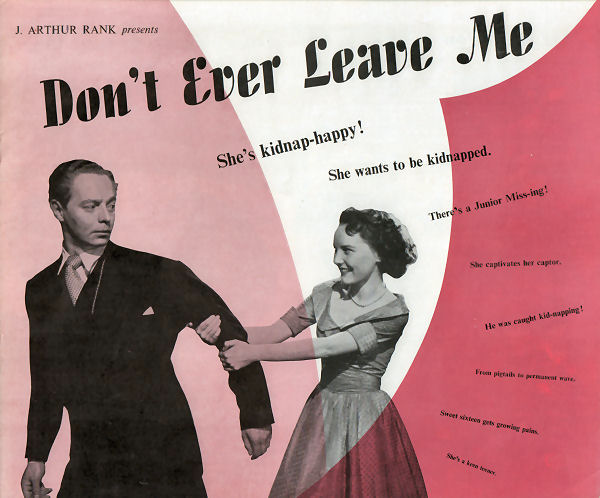
Don't Ever Leave Me press book
A charming anecdote from the Gloucester Journal in 1949 recalled
Petula's reunion with actor James Hayter, who had directed her in one of her earliest stage performances in the Army concert party Black Beret Pie. Hayter had once written in her autograph book:
"Petula Clark, who will be a great star one day. And don't forget I said it first."

The
Romantic Age trade advert
Petula's
filmography continued to expand with The Romantic Age (1949), Dance Hall (1950), White Corridors (1951), and Madame Louise (1951). In Dance Hall, filmed at Ealing Studios, she played Georgie Wilson, a teenager with dreams of ballroom glory, mastering dance skills in just five weeks that typically take years.
Petula was awarded the Institute of Dancing Bronze and Silver Medals in recognition of her performance in the film. These medals were a formal acknowledgment of her contribution to the film's dance sequences and her proficiency in performance, reflecting the standards set by the Institute at the time.
Her co-stars in Dance Hall included Douglas
Barr, Diana Dors, Donald Houston,
Kay Kendall, Bonar Colleano and Natasha Parry.

Dance
Hall trade advert
In Madame Louise, Petula explored slapstick comedy opposite Richard Hearne, and enjoyed the convenience of filming near her East Molesey home. Her punctuality was legendary-arriving at the studio with just a minute to spare after waking at 6:45 a.m.
During Made in Heaven at Pinewood Studios, Petula's evenings were anything but restful. One night, her accompanist Joe Henderson phoned from London to play a new composition over the telephone.
Petula jotted down the melody while her dinner cooled, later performing it on the studio piano to unanimous acclaim.
In The Gay Dog, Petula and Wilfred Pickles charmed audiences as father and daughter in a comedy set against the world of greyhound racing. The film featured a romantic subplot and a musical number,
"A Long Way to Go," performed in Petula's signature style.
By 1954, Petula starred in The Happiness of Three Women, a whimsical tale of wishes made at a magical well, alongside Patricia Cutts and Patricia Burke. She took on a more serious role in Track the Man Down (1955), a crime drama involving stolen greyhound takings.
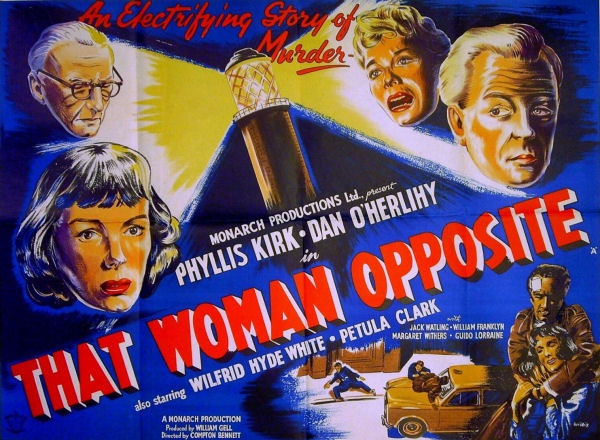
That Woman Opposite British quad poster
In That Woman Opposite (1957), Petula played Janice Lawes in a suspenseful whodunit adapted from John Dickson Carr's The Emperor's Snuff-Box. Set in a quiet coastal town, the film starred Hollywood talents Phyllis Kirk and Dan O'Herlihy, with Wilfred Hyde White rounding out the cast.
By the close of the 1950s, Petula had appeared in over two dozen films, earning praise from directors who unanimously declared,
"This girl is an actress."

6.5 Special advert in Picturegoer
Her cinematic presence continued into the 1960s. In 1958, she appeared in the 6.5 Special, working on her hit single
"Baby Lover," which reached No. 12 on the UK Singles Chart. Cameos followed in French and Italian productions, including
A Couteaux Tires (1964), for which she composed the incidental
music, and The Big T.N.T Show (1966).

Finian's
Rainbow trade advert

Goodbye,
Mr. Chips UK poster
In 1968, Petula starred as Sharon McLonergan in Finian's Rainbow, directed by Francis Ford Coppola, alongside Fred Astaire and Tommy Steele. Her performance earned a Golden Globe nomination for Best Actress in a Musical
/ Comedy. The following year, she played Katherine Bridges opposite Peter O'Toole in Goodbye, Mr. Chips, directed by Herbert Ross with music by Leslie
Bricusse.
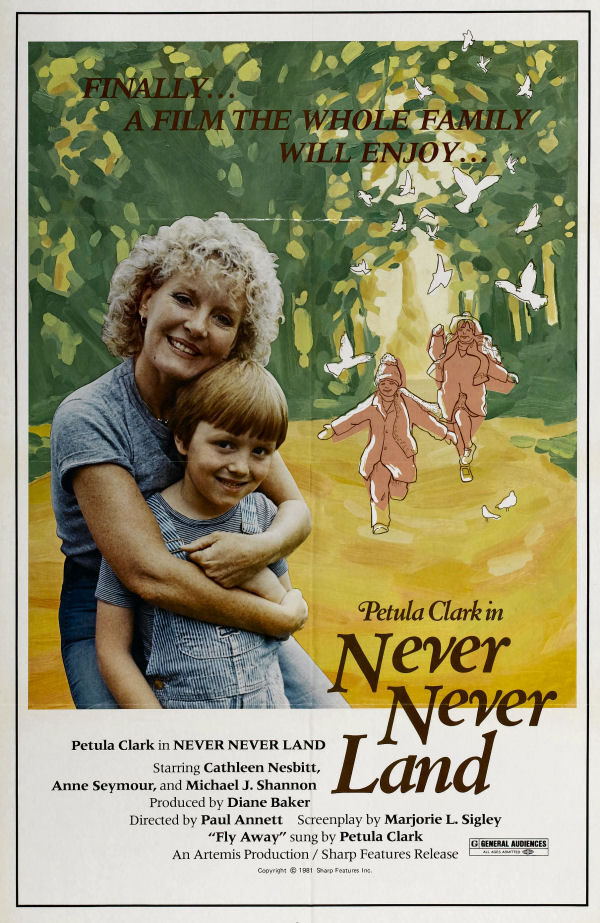
Never Never Land US poster
Petula
returned to Elstree Studios in 1980 for Never Never Land, portraying Aunt Bee in a poignant drama filmed across London. Though only broadcast on ITV in 1985, the film saw limited release in the U.S., and its theme song
"Fly Away," recorded by Petula, was later featured on an anthology CD release.
In 1989, Petula composed themes for the TV docudrama Petain, chronicling the life of Philippe
Petain. The film featured Harry Andrews in his final role and was co-produced by Dee Shipman. Portions of
Petula's score were later released on the 2007 album In Her Own Write.
From child prodigy to seasoned performer, Petula's cinematic legacy spans genres, generations, and continents,
an enduring testament to her versatility and star power.
Explore the Collection:
Dive into an extensive archive showcasing the full spectrum of Petula's film appearances. The collection features both commercially released editions and rare transfers sourced from VHS or
direct-to-DVD recordings, captured from television broadcasts where no official release exists.
It's a rich cinematic tapestry that preserves Petula's screen legacy in all its forms.
Current
holdings within the film collection have been fully digitised and
are preserved in optical disc formats, comprising both DVD and Blu-Ray
editions:
|

Medal for the General
1944
Shelf mark: [2]009
|
Strawberry Roan
1945
Shelf mark: [2]010
|

Murder in Reverse?
1945
Shelf mark: [2]131
|
I Know Where I'm Going
1945
Shelf mark: Box 20
|

Trouble at Townsend
1946
Shelf mark: Box 20 |

London Town
1946
Shelf mark: 399 |

Vice Versa
1948
Shelf mark: Box 20 |

Easy Money
1948
Shelf mark: 398 |
Here Come the Huggetts
1948
Shelf mark: Box 20 |

Vote for Huggett
1949
Shelf mark: Box 20 |

The Huggetts Abroad
1949
Shelf mark: Box 20 |

Don't Ever Leave Me
1949
Shelf mark: 397 |
The Romantic Age
1949
Shelf mark: 396 |

Dance Hall
1950
Shelf mark: 395 |

Tin Pan Alley
1951
Shelf mark: 385 |

White Corridors
1951
Shelf mark: 394 |

Madame Louise
1951
Shelf mark: 393 |

The Card
1952
Shelf mark: Box 20 |

Made in Heaven
1952
Shelf mark: 392 |

The Runaway Bus
1954
Shelf mark: Box 20 |

The Gay Dog
1954
Shelf mark: Box 21
|

The Happiness of Three Women
1954
Shelf mark: 391 |
Track the Man Down
1955
Shelf mark: 390
|
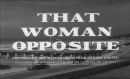
That Woman Opposite
1957
Shelf mark: 389
|
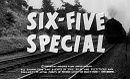
Six-Five Special
1958
Shelf mark: 388 |

A Couteaux Tires
1964
Shelf mark: Box 21 |
Questi Pazzi, Pazzi Italiani
1965
Shelf mark: Box 21 |

The Big T.N.T Show
1966
Shelf mark: 379 |

Finian's Rainbow
1968
Shelf mark: Box 21 |
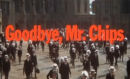
Goodbye, Mr. Chips
1969
Shelf mark: Box 21 |

Droles De Zebres
1977
Shelf mark: 221 |
Never Never Land
1980
Shelf mark: 386 / 387 |
|
Petain
1989
(as composer)
Shelf mark: 283
|
|
|
|
The Fan Archive
Collection holds an extensive and richly curated collection of
materials documenting Petula's film career. This includes
original production stills, press and publicity photographs,
vintage film and trade advertisement posters, promotional press
books, historical news clippings, movie star photo postcards and
a wide array of soundtrack recordings, each piece offering a
unique glimpse into her cinematic legacy.
|
Above:
Poster tubes and a selection of film posters and press books
maintained by the Fan Archive Collection |

We've also curated an extensive trove of over 250 issues of Picturegoer magazine that spotlight
Petula as a film star. This remarkable collection offers a vivid chronicle of her cinematic journey, beginning with her earliest screen appearances in 1944 from
a child star to a leading lady. Each issue captures a moment in time, film reviews, interviews, behind-the-scenes glimpses, and cover features, that piece together the story of Petula's film career and her timeless appeal in British popular culture.
Below is
an overview of the materials held for each film title within the
Fan Archive Collection (further accruals are expected):
1940s:
1950s:
| Film
Title |
Viewing
Copy |
Film
Stills / Lobby Cards |
Poster
/ Trade Ad |
Press
Book / Programme |
News
Cuttings |
Soundtrack
Recording / Sheet Music |
| Dance
Hall |
 |
|
|
|
|
|
| Tin
Pan Alley |
|
- |
- |
- |
- |
- |
| White
Corridors |
|
|
|
- |
|
- |
| Madame Louise |
|
|
|
- |
- |
- |
| The
Card |
|
|
|
- |
- |
- |
| Made
In Heaven |
|
|
|
- |
- |
|
| The Runaway Bus |
|
|
|
- |
- |
- |
| The Gay Dog |
|
|
|
|
- |
- |
| The Happiness of Three Women |
|
|
|
|
- |
|
| Track The Man Down |
|
|
|
- |
- |
- |
| That Woman Opposite |
|
|
|
- |
- |
- |
| Six-Five Special |
|
|
|
- |
- |
|
1960s:
| Film
Title |
Viewing
Copy |
Film
Stills / Lobby Cards |
Poster
/ Trade Ads |
Press
Book / Programme |
News
Cuttings |
Soundtrack
Recording / Sheet Music |
| A Couteaux Tires |
|
|
|
|
|
|
| Questi
Pazzi, Pazzi Italiani |
|
- |
- |
- |
- |
- |
| The Big T.N.T Show |
|
|
- |
- |
- |
- |
| Finian's Rainbow |
|
|
|
|
|
|
| Goodbye, Mr. Chips |
|
|
|
|
|
|
1970s and
1980s:
| Film
Title |
Viewing
Copy |
Film
Stills / Lobby Cards |
Poster
/ Trade Ads |
Press
Book / Programme |
News
Cuttings |
Soundtrack
Recording / Sheet Music |
| Droles De Zebres |
|
- |
- |
- |
- |
- |
| Never Never Land |
|
|
|
- |
|
|
| Petain (as composer) |
|
- |
- |
- |
- |
|

Petula: When the Actress Sings
Though celebrated for her musical triumphs, Petula's voice often shimmered through the silver screen in films not strictly billed as
musicals - moments where character and melody entwined with effortless charm.
Her first on-screen singing role came in Trouble at Townsend (1946), where she portrayed Mary Bishop and performed
"There's No Place Like Home" while accompanying herself on the piano. It was a quiet yet poignant debut that hinted at the vocal magic to come. In this performance,
Petula played the piano with the poise and assurance of a seasoned professional, delivering both music and emotion with effortless
grace.
Then came the Huggett trilogy, where Petula, as Pet Huggett, lit up British hearts. In Here Come the Huggetts (1948), she sang the cheeky
"Walking Backwards," penned by Jack Fishman and Peter Hart. The following year, Vote for Huggett featured her sweet rendition of
"In the Shade of the Old Apple Tree," and The Huggetts Abroad doubled the delight with
"House in the Sky" and the playful "Doodle-oodle-day",
all courtesy of Fishman and Hart's songwriting duo.
In Don't Ever Leave Me (1949), Petula stepped into the role of Sheila Farlaine, delivering two heartfelt numbers: the title song and
"It's Not For The Want of Trying," again by Fishman and Hart, showcasing her transition into more mature, emotionally resonant
performances.
Her voice graced Tin Pan Alley (1951) with "Have I Told You Lately That I Love
You," and in Made in Heaven (1952), she played Julie Topham, singing the
film's title track, composed by Joe Henderson with lyrics by Peggy Jones and
her father Leslie N. Clark.
In The Gay Dog (1954), Petula portrayed Sally Gay, performing "A Long Way to
Go," another Henderson-Clark collaboration, in a film that paired her with Wilfred Pickles in a
warm-hearted tale of working-class life and greyhound racing.
That same year, The Happiness of Three Women saw her as Delith, singing
"Our Love" in a story spun around wishes and wistful
dreams.
Fast forward to 1964's A Couteaux Tires, where Petula appeared as herself, singing the sultry French ballads
"Prends Garde a Toi" and "Il N'a Chante Qu'un Soir",
a nod to her international stardom and bilingual finesse. As a side
note to her cameo appearance in A Couteaux Tires, the incidental
score was composed by Petula, and issued as a six-track EP in 1964
by Vogue Records.
And finally, in Never Never Land (1980), she lent her voice to the
film's opening theme, "Fly Away," a haunting lullaby that drifted through
London's twilight streets and into television screens years later.
In tribute to Petula's on-screen vocal artistry, the archival
reference CD shown above, assembles a comprehensive selection of
these featured performances, preserved in one consolidated volume.
Note that this is for archive reference purposes only and is not for
sale.
The Films That Got Away: Petula's Unmade Cinematic Dreams
In the golden age of British cinema, Petula's name shimmered not only on marquees but in the pages of industry gossip and
tantalising press releases. Between 1951 and 1970, she was linked to a constellation of film projects that, despite the buzz, never quite made it to the screen. These were the roles that might have been, the scripts that whispered her name, and the cinematic paths left unexplored.
1951: Covent Garden - A Technicolor Dream Deferred. Anthony Asquith, one of
Britain's most respected directors, was reportedly captivated by
Petula's dramatic turn as a probationer nurse in White Corridors. So impressed, he planned to cast her in Covent Garden, an original Technicolor production set to be filmed at Pinewood Studios. The story revolved around a humble market porter who rises to operatic
fame, a role that would have required Petula to perform full operatic arias. Earl St. John, the Rank
Organisation's legendary executive producer (dubbed "The Earl of
Pinewood"), publicly declared, "I believe Petula will have a major success in
it." But despite the fanfare, the film was quietly shelved.
1951 - 1953: Peregrine's Progress - A Birthday Gift with Cinematic Ambitions.
In 1951, whispers emerged of a film adaptation of Jeffrey Farnol's
Peregrine's Progress, with Petula poised to play a gypsy girl who sings for her supper. The project was a personal
one, her father, Leslie Clark, was writing the screenplay as a birthday gift for his
daughter's 19th. In a BBC feature titled "The Film Part I Would Most Like to
Play", Petula named the role as her dream part and even suggested Dirk Bogarde as her leading man. A scene was broadcast, and the concept earned praise from listeners and Bogarde himself. Yet, the film never
materialised.
1953: Trouble in Store - A Stand for Substance in a bold
move. Petula turned down the role of Sally Wilson in Norman Wisdom's comedy Trouble in Store, citing the
character's lack of depth. "I simply couldn't go on being a sweet little girlfriend any
longer," she said at the time. Initially promised multiple songs,
Petula discovered the script offered only a single duet. The role eventually went to Lana Morris, and
Petula was suspended by the Rank Organisation. She accepted the decision with grace, stating,
"They were quite within their rights-I am not resentful about it."
1966: 9th Floor of The Plaza - An American Mystery
Mid-decade. Reports surfaced of Petula's involvement in a U.S. production titled 9th Floor of The Plaza. Details were scarce, but the project hinted at a glamorous transatlantic venture that never came to pass.
1967: Castle of Otranto - Gothic Whispers and Michael Caine.
Petula was said to be in talks for Castle of Otranto, a film to be shot on location in the United States. Rumors swirled that Michael Caine would co-star in the gothic tale. Despite the intrigue,
this castle remained un-built.
1968: Petula in the Wild West? Hollywood murmured of Petula saddling up for a
Western, in an unexpected genre twist. Though never confirmed, the idea of Petula trading ballads for buckaroos captured
imaginations!
The roles that might have been throughout the late '60s:
Petula's name was floated for several high-profile films: Elvis
Presley's Paradise, Hawaiian Style (1966), the controversial Valley of the Dolls
(1967), and the ensemble disaster epic Airport (1970). Whether due to scheduling, creative differences, or shifting tides in casting, these opportunities remained
tantalising footnotes in her career.
These "films that got away" offer a fascinating glimpse into the breadth of
Petula's appeal and the cinematic roads not taken. Each project, whether whispered in studio corridors or splashed across entertainment columns, adds texture to the legend of a performer whose talents transcended genre, geography, and expectation.
Questions?
Drop
us an email: info@petula-archives.co.uk
|
©
2001 - 2026 www.petula-archives.co.uk - All rights reserved.
This
site is lovingly curated by fans for the celebration and preservation of
Petula's legacy. Petula's trademark
is acknowledged with respect. The use of "Petula Clark"
does not imply endorsement, and serves to provide accurate information
relevant to the historical context. This falls under "fair
use," which allows for the use of trademarks when it is essential
to describe something accurately rather than to promote it. This is a
non-commercial tribute with no official affiliation.
Please
do not copy, rewrite or redistribute materials from the pages of this
website.
Researched, written, compiled, and curated by the Fan Archive Team.
Images and ephemera from the Petula Fan Archive Collection. Banner image used under license reference IY01164333, in perpetuity. Supplementary images featured on this page are items
photographed / scanned from the collection © Petula Fan Archive. Some of the content featured on this page is shared
under the fair dealing rules of UK copyright law, for purposes
such as review, commentary, reporting, archiving, and linking. We've
included selected materials with care and wherever possible, we've
acknowledged and credited the original copyright holders, with sincere
appreciation for their work and legacy.
|


